




Open any leather jacket listing and you’ll run into a pile of grades: full-grain, top-grain, genuine, bonded. They all sound like quality promises, but they mean very different things. And since a good jacket can cost a lot, it’s worth knowing which label deserves your trust.
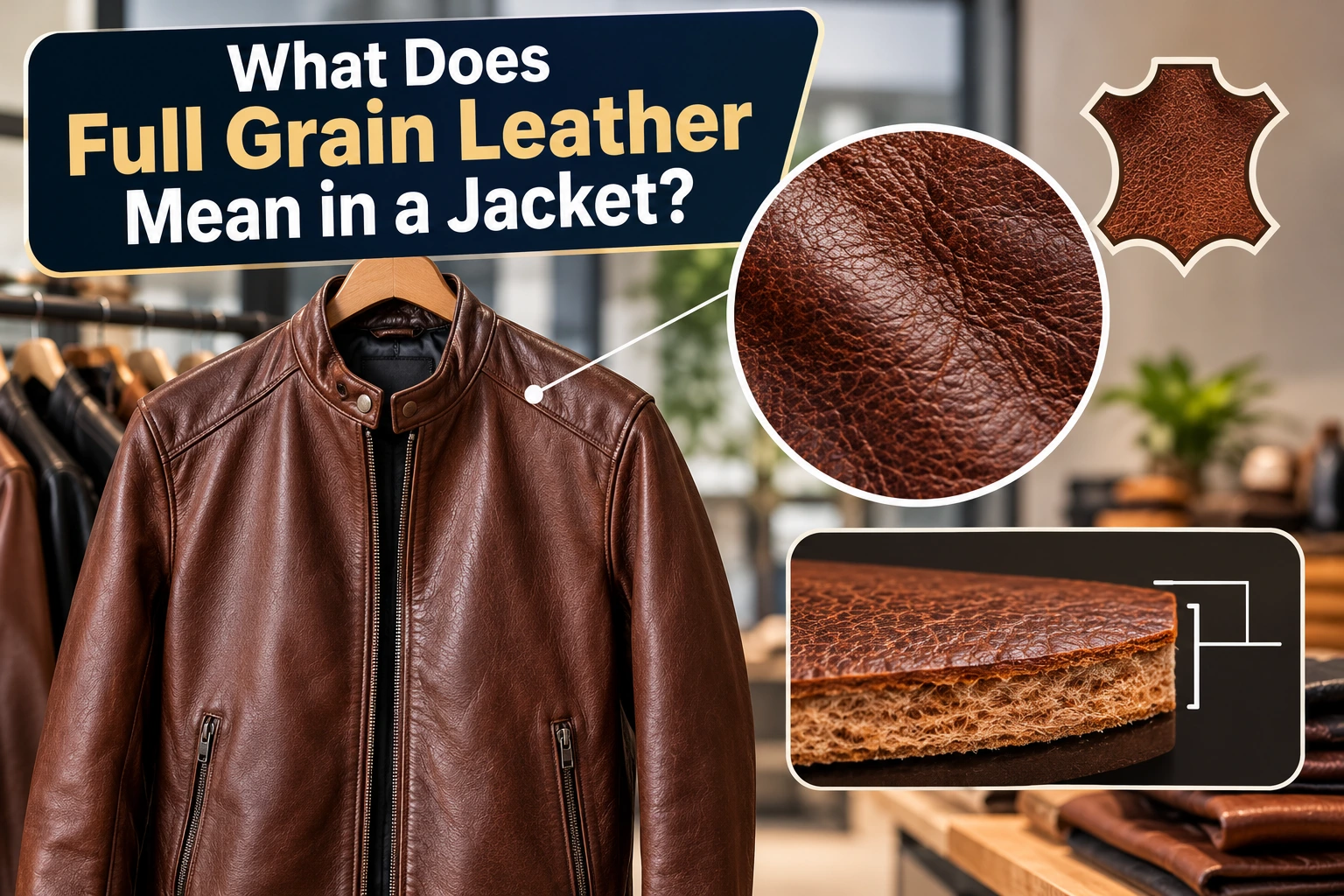
So, what is full-grain leather, and why do people pay extra for it? This guide explains the term in plain language, compares it with the other grades, and shows you how to spot the real thing before you buy.
What Is Full-Grain Leather?
Every animal hide has layers. The outermost layer, the grain side, is the strongest part, because its fibers are packed tightly together. Full-grain leather uses that top layer without sanding or buffing it away. Makers leave the surface as nature made it, scars, wrinkles, and tiny pores included.
That’s the core of the full-grain leather meaning: nothing gets removed to hide flaws. Other grades take the surface down to make it look uniform, and in doing so they remove some of the toughest fibers. If you want a short technical background on how hides are structured and processed, Wikipedia’s leather overview covers the basics.
The natural surface also explains why no two full-grain jackets look exactly alike. Every hide carries its own marks, and those marks show up in the finished jacket. Many people treat that as a feature, not a flaw, because it proves the piece came from real, undisturbed hide.
Leather Grading Explained
A quick tour of the grades makes the comparison clearer, so here is leather grading explained from top to bottom.
Full-grain sits at the top. It keeps the entire natural surface, so it holds the best fiber structure. Top-grain comes next. Makers sand the surface to remove imperfections, then apply a finish coat. The result looks cleaner and more even, though it loses some strength in the process.
Below that, you’ll see “genuine leather,” which sounds impressive but isn’t. In practice, the label usually means real leather made from the lower layers of the hide, often stamped with an artificial grain and heavily coated. It’s still leather, but it sits near the bottom of the quality ladder. Finally, bonded leather is scrap fibers glued together and covered in polyurethane. It barely counts as leather at all.
Full-Grain Leather vs Top-Grain Leather
This is the comparison buyers ask about most, and it deserves a fair answer. Full-grain leather vs top-grain leather isn’t good versus bad. Top-grain is a perfectly respectable material.
Full-grain is tougher and develops a richer character with age. It breathes better, because the pores stay open. It also costs more, and it can feel stiffer at first.
Top-grain feels softer out of the box and looks more uniform. It resists stains better, since the finish coat seals the surface. However, that coat also stops the leather from aging as beautifully, and the sanded surface wears thinner over time.
If you want a jacket that improves for decades and don’t mind a break-in period, choose full-grain. If you want instant softness and a clean look, top-grain is a sensible alternative.
Full-Grain Leather vs Genuine Leather
This comparison matters even more, because the names mislead people. Full-grain leather vs genuine leather isn’t a close contest. “Genuine” only tells you that the material came from an animal. It says nothing about which layer, how it was treated, or how long it will last.
A jacket marked “genuine leather” may look fine on day one and start cracking or peeling within a few seasons. A full-grain jacket usually looks better in year five than it did in year one. So when a seller leans on the word “genuine,” ask for the exact grade.
The Benefits of Full-Grain Leather
The benefits of full-grain leather come mostly from keeping the strongest part of the hide intact.
Durability leads the list. Tight surface fibers resist tearing and abrasion, which is why full-grain leather jacket durability is its main selling point. A well-made jacket can last for decades with reasonable care.
It also ages gracefully. As you wear it, oils from your skin, sunlight, and everyday use darken and soften the surface. This process builds a leather patina over time, and no two jackets develop the same one. Scratches blend in, creases settle, and the color deepens.
Finally, it breathes. Open pores let moisture escape, so a full-grain jacket usually feels more comfortable across seasons than heavily coated alternatives.
How Tanning and Finishing Affect Quality
The grade tells only part of the story. Leather tanning and finishing also shape how a jacket looks and feels. Tanners treat hides with either vegetable extracts or chromium salts. Vegetable tanning is slower and gives a firmer leather with a rich natural patina. Chrome tanning is faster and produces a softer, more flexible leather, and it’s common in jackets.
Finishing comes next. Some makers apply only a light dye and wax, which keeps the natural look. Others add a thick pigment coat that hides the grain. When you’re judging leather hide quality, ask about both the tanning method and the finish, because a great hide can still lose its character under heavy coating.
How to Identify Full-Grain Leather
You can’t always trust a label, so learn a few checks. Here’s how to identify full-grain leather without special tools.
Look closely at the surface first. Real full-grain has small irregularities: uneven pores, light scars, slight color changes. A surface that looks perfectly uniform, like a printed pattern, suggests that someone sanded and embossed it. Next, look at the edges. Real leather shows rough, fibrous edges, while synthetic material shows a smooth plastic-like layer.
Touch helps too. Full-grain feels warm, slightly uneven, and a little oily. Plastic feels cool and slick. You can also press a finger into the surface. On real leather, tiny wrinkles form and spread, much like skin does.
Smell matters as well. Genuine leather has an earthy, natural scent, while synthetic material smells chemical. Of course, none of these checks is perfect on its own. Use several together, and buy from a seller who states the grade clearly. If you want to know more about how we describe our materials, read about Royalex Leather.
Full-Grain Leather Jacket Price: What to Expect
The full-grain leather jacket price runs higher than for other grades, and that’s reasonable. Makers need better hides, since they can’t hide flaws, and fewer hides qualify. The material also takes more skill to cut and sew, because it’s thicker and less forgiving.
Prices vary widely by brand, hide type, and construction, so I won’t quote numbers. Instead, think in terms of cost per wear. A cheaper coated jacket might need replacing every few years, while a full-grain one can serve you for a decade or more. For a deeper look at current options, browse our guide to the top men’s leather jackets for 2026. Watching for discounts also helps, and our leather jacket sale page lists current offers.
Is Full-Grain Leather Worth It?
So, is full-grain leather worth it? For most people who plan to keep a jacket for years, yes. You pay more up front and receive a stronger, better-aging piece in return. If you only want a trendy jacket for a single season, a lower grade may be enough.
One practical example is our John Dutton Yellowstone leather jacket, which uses heavy-gauge, full-grain distressed cowhide, the kind of leather jacket material quality that rewards years of wear.
Leather Jacket Care and Maintenance
Even the toughest hide needs a little attention, so keep leather jacket care and maintenance simple. Wipe dust off with a soft, slightly damp cloth, and apply a good leather conditioner once or twice a year. Keep the jacket away from radiators and direct sun, since heat dries leather out. If it gets wet, let it dry naturally, then condition it afterward. Finally, hang it on a wide, shaped hanger rather than a thin wire one.
Treat it well, and the natural leather grain will darken and soften into something truly your own.
Ready to Buy a Full-Grain Leather Jacket?
Now that you know what to look for, browse the full Royalex Leather collection and compare cuts, colors, and materials. Shop now and choose a jacket built to last.
Frequently Asked Questions
What is full-grain leather in simple terms?
It’s leather made from the top layer of the hide, left in its natural state without sanding away the surface. That keeps the strongest fibers and the natural grain, which is why it lasts longer than other grades.
Is full-grain leather better than top-grain leather?
For durability and aging, yes. Full-grain is stronger and develops a richer patina. Top-grain feels softer at first and looks more uniform, so some people prefer it for comfort and a clean appearance.
Is genuine leather the same as full-grain leather?
No. “Genuine leather” only means the material comes from real hide, usually the lower layers, often coated and embossed. Full-grain is the top layer and sits at the top of the quality ladder.
How long does a full-grain leather jacket last?
With reasonable care, it can last for decades. Exact lifespan depends on the hide, construction, and how often you wear and maintain it.
Why is a full-grain leather jacket more expensive?
Better hides, fewer usable pieces, and more demanding craftsmanship all raise the cost. You also pay for a jacket that lasts far longer than lower grades.
How can I tell if a jacket is really full-grain leather?
Check for natural surface irregularities, fibrous edges, an earthy smell, and a surface that wrinkles like skin when you press it. Also ask the seller to state the exact leather grade.
Does full-grain leather need special care?
It needs basic care, not anything complicated. Wipe it clean, condition it once or twice a year, keep it away from heat, and store it on a wide hanger.
